
In today’s digital ecosystem, paid social media advertising remains one of the most cost-effective methods for acquiring leads, scaling e-commerce revenue, and expanding global brand awareness. At the center of this landscape is Meta Ads—the primary advertising platform spanning Facebook, Instagram, Messenger, and the Meta Audience Network.
Whether you run a fast-growing direct-to-consumer (DTC) store, a B2B service agency, or a local business, understanding how to harness Meta Ads is critical for sustained growth. This comprehensive guide covers everything from account setup and audience targeting to advanced AI-driven campaign optimizations.
What Are Meta Ads?
Meta Ads are paid marketing messages displayed across Meta’s family of apps and services. Unlike traditional search engine marketing (SEM), where users actively look for specific keywords, Meta advertising functions on demographic, behavioral, and interest-based targeting.
By leveraging machine learning and rich user data, Meta enables advertisers to serve personalized visual creativeranging from single images and carousel cards to vertical video Reels—directly into the feeds of users who are most likely to engage or convert.
Key Advantages of Meta Ads
- Unrivaled Reach: Millions of daily active users across Facebook, Instagram, and Messenger.
- Granular Data & AI Matching: Meta’s Advantage+ machine learning engines continuously refine ad placement and user matching in real time.
- Diverse Ad Formats: Engage prospects through Stories, Feed placements, Reels, and In-Stream video ads.
- Full-Funnel Capabilities: Support for top-of-funnel brand discovery down to bottom-of-funnel retargeting and retention.
Navigating Meta Ads Manager
To launch and manage campaigns, advertisers use Meta Ads Manager, a central dashboard designed to build campaigns, organize budget allocations, and analyze performance metrics.
Meta Ads Manager interface dashboard. Source: Madgicx
The 3-Tier Campaign Hierarchy
Every campaign created inside Meta Ads Manager follows a strict three-level structure:
- Campaign Level: The overarching structure where you define your primary objective (e.g., Sales, Leads, Awareness).
- Ad Set Level: The targeting and delivery operational hub where you set audiences, budgets, schedules, bid strategies, and placement choices.
- Ad Level: The creative output consisting of images, videos, primary copy, headlines, call-to-action (CTA) buttons, and destination URLs.
Understanding Meta Ad Campaign Objectives
Selecting the right campaign objective is essential because it instructs Meta’s delivery algorithm on what conversion outcome to optimize for. Meta consolidates campaign objectives into six core categories:
| Campaign Objective | Ideal Goal / Use Case | Key Performance Metrics (KPIs) |
|---|---|---|
| Awareness | Broad reach, brand discovery, video views | Reach, Impressions, Cost Per 1,000 Impressions (CPM) |
| Traffic | Driving clicks to website, landing page, or blog | Click-Through Rate (CTR), Cost Per Click (CPC) |
| Engagement | Post interactions, Page likes, event RSVPs, messages | Cost Per Engagement, Messaging Conversations |
| Leads | Instant form submissions, calls, lead generation | Cost Per Lead (CPL), Form Completion Rate |
| App Promotion | Driving mobile app installs and in-app events | Cost Per Install (CPI), Cost Per Action (CPA) |
| Sales | E-commerce purchases, catalog sales, conversions | Return on Ad Spend (ROAS), Cost Per Acquisition |
Structuring a Meta Ads Funnel Strategy
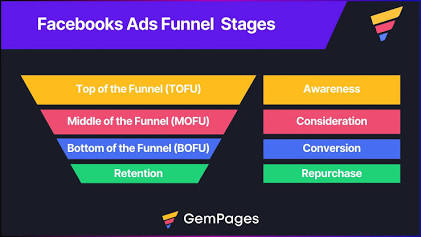
To maximize conversion performance, structure your campaigns into a multi-stage funnel that aligns with your buyer’s journey.
Full-funnel digital marketing approach. Source: GemPages
Top of Funnel (TOFU) – Prospecting & Awareness
At the top of the funnel, target cold audiences who have never interacted with your brand. The goal here is education and problem recognition. Focus on eye-catching visual hooks, value-driven video content, and educational ads.
Middle of Funnel (MOFU) – Consideration & Intent
In the middle of the funnel, target warm audiences who have engaged with your social channels, watched videos, or visited your website without purchasing. Content here should highlight social proof, customer testimonials, case studies, and comparative advantages.
Bottom of Funnel (BOFU) – Conversion & Retargeting
At the bottom of the funnel, focus on hot prospects who added items to their cart or abandoned checkout. Deliver urgency-driven messaging, limited-time discount incentives, or risk-reversal guarantees (e.g., free shipping or money-back offers).
Post-Purchase & Retention
Retain existing buyers by cross-selling complementary items, introducing subscription options, or promoting new product launches.
Audience Targeting Options in Meta Ads
Meta offers three primary audience targeting categories to help you reach the right audience segment:
1. Core Audiences
Manual targeting based on explicit user characteristics:
- Demographics: Age, gender, relationship status, education, job titles.
- Geographic Location: Country, region, city, zip code, or radius around a address.
- Interests & Behaviors: Pages liked, devices used, purchasing habits, and industry interests.
2. Custom Audiences
High-intent retargeting groups built from proprietary first-party data:
- Website Visitors: Tracked via the Meta Pixel or Conversions API.
- Customer Match Lists: Uploaded email or phone subscriber databases.
- Engagement Audiences: Users who interacted with your Instagram profile, Facebook page, or video content.
3. Lookalike Audiences (LLAs)
Machine-learning generated segments of new users who share traits, behaviors, and demographics with your source Custom Audiences (e.g., a 1% Lookalike of your top 10% highest lifetime-value customers).
Advanced Meta Ads Optimization & Scaling Strategies
Advantage+ Campaigns & Automation
Meta continues to shift towards machine-learning automation. Key features include:
- Advantage+ Shopping Campaigns (ASC): Fully automated e-commerce campaigns that continuously test creative combinations and audience allocations to maximize sales.
- Advantage+ Audience: Expands targeting automatically beyond defined parameters if the algorithm detects higher conversion probability.
- Advantage+ Placements: Automatically distributes creative across all available placements (Feed, Stories, Reels, Audience Network) to lower overall CPMs.
Budget Management: CBO vs. ABO
- Campaign Budget Optimization (CBO): You set a single budget at the campaign level, and Meta automatically distributes funds dynamically to the best-performing ad sets.
- Ad Set Budget Optimization (ABO): You set strict budgets per ad set, giving you manual control over how much spend goes to specific target groups.
Pro Tip: Use ABO for testing new audiences and creative concepts under equal conditions. Switch to CBO or Advantage+ when scaling winning variations.
Tracking & Measurement: Meta Pixel & Conversions API (CAPI)
Accurate tracking is essential for optimizing ad delivery and measuring performance correctly. Relying solely on browser-based pixel tracking is no longer sufficient due to browser privacy updates (such as Apple iOS App Tracking Transparency).
Implementing Server-Side Measurement
To ensure complete attribution data:
- Meta Pixel: Client-side JavaScript snippet placed on your website to record browser events (PageViews, AddToCart, Purchase).
- Conversions API (CAPI): Server-side integration that sends web and offsite events directly from your server to Meta, bypassing browser ad blockers and cookie restrictions.
- Event Deduplication: Match event IDs across Pixel and CAPI to ensure conversions are accurately counted without duplication.
Best Practices for High-Converting Meta Creative
Creative quality is now the single largest lever for performance inside Meta Ads Manager.
- Hook in the First 3 Seconds: Grab immediate visual attention before users scroll past.
- Design for Sound-Off Viewing: Use clear text overlays and subtitles on video creative.
- Prioritize Vertical Aspect Ratios: Utilize 9:16 vertical video for mobile-first surfaces like Instagram Reels and Stories.
- Leverage User-Generated Content (UGC): Authentically styled unboxing videos and customer reviews often outperform slick, studio-shot brand ads.
- Maintain Creative Diversity: Avoid running identical single-image ads. Balance your ad account with static image hooks, carousel product grids, and short-form video reels.
Frequently Asked Questions
What is a good daily starting budget for Meta Ads?
For new accounts testing product-market fit, start with a daily budget equal to 2x to 3x your target Cost Per Acquisition (CPA) per ad set. For example, if your target CPA is $20, test at $40 to $60 per day to provide enough data for Meta’s learning phase.
How long does the “Learning Phase” take?
An ad set needs approximately 50 optimization events (e.g., 50 purchases or 50 leads) within a 7-day window to exit the learning phase and achieve stable delivery.
How do I combat ad fatigue?
If frequency rises above 3.0 to 4.0 and performance drops, refresh your visual creative, update primary copy, or expand your audience size.
Gemini is AI and can make mistakes.