

Search Engine Optimization (SEO) is the foundational engine behind organic digital visibility. Every single day, billions of queries are typed into search engines like Google, Bing, and DuckDuckGo. Users are looking for solutions, buying products, researching complex topics, or navigating to specific web pages.
If your website fails to rank on the first page of search results, you are effectively invisible to the vast majority of your target audience. This comprehensive guide breaks down the core principles, mechanics, and strategies of SEO so you can build long-term organic authority and sustained search traffic.
1. What is SEO and Why Is It Critical?
SEO (Search Engine Optimization) is the art and science of optimizing a web page and digital ecosystem to increase its visibility in organic (non-paid) search engine result pages (SERPs). Unlike pay-per-click (PPC) advertising—where traffic stops the second your budget depletes SEO generates compounding, long-term returns.
+———————————————————————–+
| WHY SEO MATTERS |
+———————————————————————–+
| 1. Organic Trust | 53%+ of all web traffic comes from organic |
| | search; users trust organic over paid ads. |
|————————+———————————————-|
| 2. Cost Efficiency | High ROI over time with low marginal cost per|
| | visitor once rankings are established. |
|————————+———————————————-|
| 3. Intent Matching | Captures users at the exact moment of search |
| | intent, yielding high conversion rates. |
|————————+———————————————-|
| 4. Competitive Edge | Outranking competitors captures market share |
| | before buyers evaluate alternatives. |
+———————————————————————–+
The Three Pillars of Search Engine Optimization
To execute an effective strategy, you must view SEO as a balanced triangle consisting of three interdependent disciplines:
- Technical SEO: Ensuring search engines can crawl, index, and render your site without structural friction.
- On-Page SEO: Crafting high-quality content optimized for specific keywords, user intent, structured data, and semantic relevance.
- Off-Page SEO: Establishing external authority, domain reputation, and brand credibility through backlinks, mentions, and digital PR.
2. How Search Engines Work: Crawling, Indexing, and Ranking
Before implementing any tactic, you must understand how algorithms evaluate websites. Search engines operate in three distinct sequential phases:
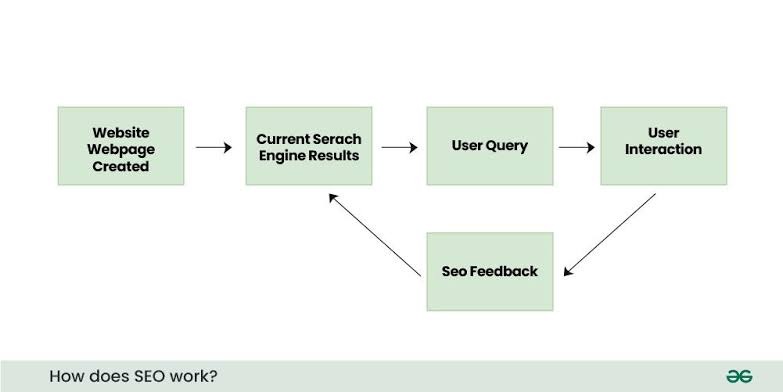
Workflow of search engine indexing and feedback. Source: GeeksforGeeks
Step 1: Crawling
Search engines use automated software bots—commonly referred to as “spiders” or “crawlers” (such as Googlebot)—to discover public web pages. Crawlers travel across the internet by following hyperlinks from known pages to new ones. If a page has no internal or external links pointing to it, it becomes an “orphan page” and cannot easily be discovered by crawlers.
Step 2: Indexing
Once a spider crawls a page, the search engine processes and analyzes its content, including HTML code, text, image media, schema markup, and renderable JavaScript. If the page meets quality standards, it is saved in a massive global database called the search index.
Step 3: Ranking
When a user submits a search query, the search engine scans its index to pull the most relevant, authoritative, and fast-loading pages. Algorithms evaluate hundreds of ranking signals—such as topical relevance, domain authority, page speed, mobile usability, user location, and backlinks—to display the results in milliseconds.
3. Core Pillar 1: Keyword Research & Search Intent
Keyword research forms the strategic bedrock of all SEO initiatives. Without knowing what terms your potential audience searches for, any content creation effort is merely guesswork.
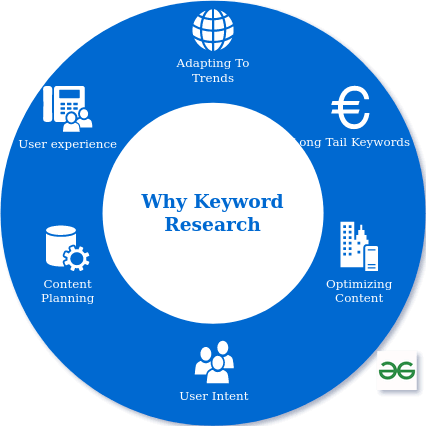
Strategic pillars of effective keyword research. Source: GeeksforGeeks
Understanding the Four Types of Search Intent
Modern search engines do not just match exact text phrases; they analyze user intent—the underlying reason why someone typed a specific query.
| Intent Category | Description | Example Query | Content Type Needed |
| Informational | User wants to learn or understand a topic | “How does SEO work?” | Detailed guides, tutorials, articles |
| Navigational | User wants to reach a specific brand or URL | “Google Search Console login” | Brand landing pages, direct portals |
| Commercial | User is comparing options before buying | “Best SEO tools for small business” | Comparison tables, reviews, lists |
| Transactional | User is ready to purchase immediately | “Buy Ahrefs subscription” | Product pages, checkout pages |
The Keyword Research Framework
- Identify Seed Terms: Start with broad topics central to your industry, product, or service offerings.
- Expand with Tools: Use tools like Google Keyword Planner, Ahrefs, SEMrush, or Ubersuggest to uncover search volume, keyword difficulty (KD), and related variations.
- Target Long-Tail Keywords: Focus on specific phrases containing three or more words (e.g., “technical SEO checklist for e-commerce sites”). While they carry lower individual search volume, long-tail terms bring higher conversion rates and face lower competition.
- Analyze SERP Features: Search the target phrase manually on Google. Examine whether the page displays featured snippets, “People Also Ask” accordions, video carousels, or local packs to tailor your format accordingly.
4. Core Pillar 2: On-Page SEO & Content Optimization
On-page SEO focuses on optimizing the element structure and content of individual web pages to rank higher and earn more relevant traffic.
Title Tags and Meta Descriptions
- Title Tag: The single most impactful on-page text element. Keep titles between 50 and 60 characters, place the primary keyword near the beginning, and write compelling copy to boost Click-Through Rates (CTR).
- Meta Description: A brief summary (120–155 characters) appearing below the title tag in SERPs. While not a direct ranking factor, a well-crafted meta description improves click-through behavior.
Header Structure (H1, H2, H3)
Organize your article or page logically using standard HTML headings:
- H1: Reserved strictly for the primary title (one per page).
- H2: Used for main section topics.
- H3–H4: Used for sub-points under H2 sections.
Content Depth and E-E-A-T
Google evaluates content quality using its E-E-A-T guidelines:
- Experience: Direct, first-hand experience with the topic.
- Expertise: Formal or practical knowledge demonstrating subject competence.
- Authoritativeness: Recognition as a reliable go-to source in your niche.
- Trustworthiness: Accuracy, transparent sourcing, security (HTTPS), and clear ownership metadata.
+———————————————————————–+
| ON-PAGE SEO BEST PRACTICES CHECKLIST |
+———————————————————————–+
| [ ] Primary Keyword in H1, Title Tag, and First 100 Words |
| [ ] Descriptive, Short URLs (e.g., domain.com/seo-guide) |
| [ ] Comprehensive Content Addressing Full Search Intent |
| [ ] Internal Links to Relevant Content (3-5 minimum) |
| [ ] External Links to Reputable High-Authority Sources |
| [ ] Optimized Images (Compressed, WebP format, Descriptive Alt Text) |
+———————————————————————–+
5. Core Pillar 3: Technical SEO & Site Architecture
Technical SEO ensures that search engines can easily access, crawl, render, and index your website without running into technical barriers.
Core Web Vitals & Page Speed
Google includes Core Web Vitals as explicit user experience ranking metrics:
- Largest Contentful Paint (LCP): Measures perceived loading speed. Target: ≤ 2.5 seconds.
- Interaction to Next Paint (INP): Measures page responsiveness to user input. Target: ≤ 200 milliseconds.
- Cumulative Layout Shift (CLS): Measures visual stability during loading. Target: ≤ 0.1.
Key Technical Elements
- Robots.txt: A text file located at the root directory (/robots.txt) telling web crawlers which pages or folders they can or cannot crawl.
- XML Sitemap: A structured file (/sitemap.xml) listing all critical URLs to help search engines locate and index content efficiently.
- Canonical Tags (rel=”canonical”): An HTML tag placed in the <head> to specify the primary version of a duplicate or near-duplicate page, preventing duplicate content penalties.
- HTTPS / SSL: Security certificates are a basic ranking factor; unencrypted http:// sites are flagged as unsafe by modern browsers.
- Mobile-First Indexing: Google primarily uses the mobile version of a site’s content for indexing and ranking. Pages must be fully responsive across mobile devices.
6. Core Pillar 4: Off-Page SEO & Authority Building
Off-page SEO encompasses all activities conducted outside of your website to build brand reputation and search authority.
Backlinks: The Currency of Web Authority
A backlink is a hyperlink from an external website pointing to your site. Search engines treat backlinks like votes of confidence. However, quality far outweighs quantity:
- High-Authority Backlinks: Links from established, trusted publications (e.g., major news outlets, industry journals, educational institutions) pass significant domain authority (“link juice”).
- Low-Quality / Spam Links: Unnatural, paid, or directory-spam links can trigger manual search penalties or be actively ignored by Google algorithms.
Proven Off-Page Strategies
- Digital PR: Pitching original research, survey data, or industry analysis to journalists and trade publications.
- Guest Blogging: Writing high-value contributions for authoritative industry blogs in exchange for contextual links.
- Unlinked Brand Mentions: Reaching out to websites that mention your company or brand name without linking to request a hyperlinked attribution.
- Broken Link Building: Finding broken links on high-authority sites in your space and offering your content as a replacement.
7. Measuring SEO Performance: Key Metrics & Analytics
You cannot optimize what you do not measure. Tracking performance ensures your efforts yield tangible business value.
+———————————————————————–+
| ESSENTIAL SEO METRICS TO TRACK |
+———————————————————————–+
| Metric | Source | Purpose |
|————————+—————————+——————|
| Organic Traffic | Google Analytics 4 (GA4) | Overall visitors |
| Organic Conversions | GA4 | Revenue / Leads |
| Impressions & Clicks | Google Search Console | Search visibility|
| Keyword Rankings | Ahrefs / SEMrush | SERP positioning |
| Domain Authority / Rating| Third-Party Tools | Relative strength|
+———————————————————————–+
Essential Free Tools
- Google Search Console (GSC): Monitors indexing issues, search queries, click-through rates, impression volumes, and technical errors directly from Google.
- Google Analytics 4 (GA4): Analyzes user behavior, session engagement, conversion paths, and traffic acquisition channels.
- PageSpeed Insights: Evaluates Core Web Vitals and provides actionable technical performance advice.
8. The Future of SEO: AI Search & Generative Experience
The SEO landscape is shifting rapidly with the rise of artificial intelligence, natural language understanding, and conversational search engines.
Generative AI and Search (SGE / AI Overviews)
Search engines are increasingly summarizing web content directly in SERPs using Large Language Models (LLMs). To remain visible in an AI-driven search ecosystem:
- Focus on providing unique insights, proprietary data, and real personal experience that AI engines cannot easily synthesize from generic web data.
- Structure content cleanly using bullet points, tables, concise definitions, and clear schemas so AI engines can extract your site as a cited source.
Voice Search and Conversational Queries
With the prevalence of smart assistants and mobile voice search, queries are becoming longer and more conversational. Optimizing for direct question-and-answer formats helps capture voice and zero-click search snippets.
9. Conclusion: A Master SEO Action Plan
Sustainable SEO success requires consistent strategy, quality content, and ongoing optimization. Use this summary workflow to guide your day-to-day execution:
- Audit: Perform a technical audit to resolve crawl errors, speed bottlenecks, and broken links.
- Research: Target keywords with clear user intent and low-to-medium competition.
- Create: Produce authoritative, original content structured around E-E-A-T principles.
- Optimize: Fine-tune on-page elements—title tags, meta descriptions, image alt text, and internal links.
- Promote: Build external trust through PR, outreach, and high-value backlinks.
- Analyze: Review performance metrics monthly in Google Search Console and GA4 to iterate continuously.