
Whether launching a multi-million dollar marketing campaign, writing a simple sales email, or designing a landing page, copywriting is the single most valuable skill in modern business. Words hold the unique power to inspire action, shift perspectives, and convert passive readers into loyal customers.
This comprehensive guide breaks down the science, psychology, and strategic art of copywriting, equipping you with proven frameworks, actionable strategies, and SEO best practices to write copy that drives real measurable revenue.
What Is Copywriting? (And Why It Matters)
At its core, copywriting is the strategic process of writing persuasive text (known as “copy”) designed to prompt the reader to take a specific, intended action. That action might be purchasing a product, subscribing to a newsletter, filling out a contact form, downloading a whitepaper, or clicking a button.
Unlike general creative writing or news journalism, copywriting is inherently purpose-driven and measurable. It operates at the intersection of psychology, marketing strategy, and clear communication.
[ Audience Insight ]
+
[ Persuasive Framework ]
+
[ Clear Call to Action (CTA) ]
=
High-Converting Copywriting
Copywriting vs. Content Writing: What’s the Difference?
While both disciplines involve writing for the web, their core objectives, execution, and key performance indicators (KPIs) differ significantly:
| Feature | Copywriting | Content Writing |
| Primary Goal | Drive immediate action or conversion | Educate, inform, entertain, and build trust |
| Key Formats | Sales pages, ads, landing pages, CTAs, emails | Blog posts, e-books, guides, news articles |
| Pacing & Tone | Direct, persuasive, concise, punchy | Narrative, informative, comprehensive, conversational |
| Focus | Benefits, offers, solutions, urgency | Topics, tutorials, industry insights, authority |
| Success Metrics | Conversion rate, CTR, sales volume, ROI | Organic traffic, time on page, shares, brand recall |
Understanding this distinction ensures that every word you write aligns perfectly with your marketing goals.
The Psychology Behind Effective Copywriting
Great copywriters are not just talented wordsmiths—they are keen observers of human decision-making. Before writing a single headline, successful copywriters seek to understand the emotional drivers that motivate human behavior.
1. Features vs. Benefits
One of the foundational rules of copywriting is prioritizing benefits over features.
- Feature: What the product is or has (e.g., “This laptop has a 12-hour lithium-ion battery”).
- Benefit: What the feature does for the reader (e.g., “Work uninterrupted all day without hunting for a power outlet”).
People rarely buy features; they buy the outcomes, emotional states, and efficiency improvements that those features provide.
2. Emotional Drivers and Rational Justifications
Psychological research shows that humans make decisions based on emotion and then use logic to justify those decisions after the fact.
Effective copywriting taps into primary emotional triggers:
- Desire for transformation: Moving from a “before” state of frustration to an “after” state of relief or success.
- Fear of missing out (FOMO): Leveraging scarcity or urgency to encourage timely decision-making.
- Status and belonging: Aligning product adoption with professional prestige or social standing.
Proven Copywriting Frameworks
When faced with a blank page, professional copywriters rely on battle-tested structural formulas to structure their message systematically.
The AIDA Model
The AIDA framework is the classic gold standard of copywriting:
- Attention: Grab the reader’s eye with a compelling, benefit-focused headline or provocative statement.
- Interest: Hold their attention by introducing relatable pain points, surprising statistics, or engaging stories.
- Desire: Build an appetite for your solution by detailing vivid benefits, social proof, and clear transformations.
- Action: Guide the reader smoothly toward a clear, low-friction Call to Action (CTA).
Additional High-Converting Frameworks
1. PAS (Problem – Agitate – Solve)
- Problem: Identify the specific frustration your ideal audience is experiencing.
- Agitate: Emphasize the emotional or financial cost of leaving that problem unresolved.
- Solve: Introduce your product or service as the ultimate, hassle-free solution.
2. BAB (Before – After – Bridge)
- Before: Describe the reader’s current, sub-optimal reality.
- After: Paint a vivid picture of a world where their problem is completely solved.
- Bridge: Show them step-by-step how your solution takes them from “Before” to “After.”
3. The 4 Ps (Promise – Picture – Proof – Push)
- Promise: Make a bold, compelling promise in your opening section.
- Picture: Help the reader visualize the positive impact on their life or work.
- Proof: Back up your claims with hard data, testimonials, case studies, or demos.
- Push: Encourage them to take action immediately with clear direction and appropriate urgency.
Crafting Headlines That Stop the Scroll
David Ogilvy, widely considered the father of modern advertising, famously stated that 80 cents of your advertising dollar is spent on the headline. If your headline fails to hook the reader, the rest of your copy remains unread.
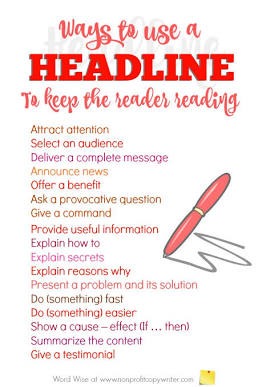
Headline Strategies That Retain Readers. Source: Nonprofit Copywriter
The 4 U’s of Powerful Headlines
To maximize reader retention and click-through rates, test your headlines against the 4 U’s:
- Useful: Does it offer obvious value to the reader?
- Urgent: Is there a reason to read or click right now?
- Unique: Does it stand out from typical, generic online content?
- Ultra-specific: Does it use exact numbers, specific claims, or tangible details?
Proven Headline Formulas
- The How-To Formula: How to [Achieve Desired Outcome] Without [Pain Point]
- Example: How to Master Copywriting Without Spending Years in Marketing School
- The Listicle Formula: [Number] Proven Ways to [Solve Problem] Fast
- Example: 7 Proven Copywriting Frameworks to Double Your Conversion Rates
- The Direct Curiosity Formula: The Counterintuitive Secret to [Desired Result]
- Example: Why Concise Copywriting Outperforms Flashy Design Every Time
How to Write Persuasive Body Copy
Once your headline grabs attention, your body copy must maintain momentum, answer unspoken objections, and build compelling value.
1. Write for Scannability
Online readers rarely consume text word-for-word; instead, they scan in an “F-shaped” pattern looking for quick takeaways.
- Use short, punchy paragraphs (1–3 sentences max).
- Incorporate bold key phrases to highlight vital terms.
- Break up dense technical details using bullet points and numbered lists.
- Use clear ## and ### subheadings every 200–300 words.
2. Maintain a One-on-One Conversational Tone
Write as if you are speaking directly to a single individual rather than addressing a crowd. Use the second-person pronoun (“you”) far more often than first-person pronouns (“I”, “we”, or “our company”).
Weak Copy: “Our platform offers enterprise teams streamlined document management features.”
Persuasive Copy: “You can instantly organize, track, and approve team documents without endless email threads.”
3. Handle Objections Proactively
Every potential buyer experiences internal resistance before taking action. Address common friction points directly within your copy:
- Price Concern: Contrast the cost of your product against the much higher cost of leaving the problem unsolved.
- Time Concern: Emphasize rapid onboarding, quick setup, or immediate implementation.
- Trust Concern: Insert client logos, star ratings, case study quotes, and explicit satisfaction guarantees near purchase decision points.
Mastering SEO Copywriting for Search Visibility
Writing persuasive copy is only half the battle; your audience must be able to find it organically via search engines like Google. SEO copywriting blends human psychology with strategic keyword integration.
Essential On-Page SEO Copywriting Guidelines
- Strategic Keyword Placement: Integrate your primary target keyword (“copywriting”) naturally into high-priority locations:
- Main Title (H1 Tag)
- The first 100 words of introductory body text
- At least two Subheadings (H2/H3 Tags)
- The Meta Title and Meta Description
- Natural occurrences throughout body paragraphs (aiming for natural language flow rather than artificial keyword stuffing)
- Fulfill Search Intent Completely: Google prioritizes content that answers a searcher’s query thoroughly. Provide clear answers, actionable examples, and structured data tables to maximize search ranking relevance.
- Optimize Meta Descriptions for Clicks: Your meta description acts as organic ad copy on search engine result pages (SERPs). Keep it under 155 characters, include your primary keyword, and conclude with an inviting call to click.
Designing Clear Calls to Action (CTAs)
Your Call to Action is the climax of your copywriting effort. A weak, vague, or buried CTA causes potential conversions to slip away at the last second.
Action-Oriented CTA Design Tips
- Use Strong Command Verbs: Swap passive phrases like “Submit” or “Click Here” for active, value-led language like “Get My Free Guide,” “Start Writing Copy Today,” or “Claim Your Discount.”
- First-Person Framing: Testing shows that switching CTA text from second-person to first-person can increase click-through rates significantly:
- Standard: “Start Your 14-Day Free Trial”
- High-Converting: “Start My Free 14-Day Trial”
- Reduce Friction Near the CTA: Place supporting micro-copy directly beneath the button, such as “No credit card required,” “Cancel anytime,” or “Takes under 2 minutes.”
Common Copywriting Mistakes to Avoid
Even experienced writers occasionally fall into traps that degrade copy effectiveness. Watch out for these common errors:
- Using Jargon and Industry Buzzwords: Overused buzzwords like “synergy,” “cutting-edge,” or “next-generation” sound vague and erode trust. Choose simple, direct, and universally understood words instead.
- Focusing on the Business Instead of the Customer: Keep your copy audience-centric. Focus on solving their challenges rather than boasting about your company history.
- Neglecting Proofreading and Readability: Grammar mistakes, awkward sentences, and dense blocks of text signal a lack of quality control and undermine authority.
- Failing to Create Appropriate Urgency: Without a compelling reason to act now, readers routinely defer decisions and forget to return.
The Essential Copywriting Editing Checklist
Before publishing or sending your copy live, run your draft through this final review checklist:
- [ ] Headline Check: Does the headline contain a clear benefit, specific detail, or compelling hook?
- [ ] Readability Check: Are sentences varied in length? Is text broken into scannable chunks with short paragraphs?
- [ ] Benefit Audit: Have you highlighted how features translate into real-world reader benefits?
- [ ] Audience Focus: Is the word “you” used significantly more frequently than “we” or “I”?
- [ ] Proof & Trust: Are testimonials, case studies, or empirical data included to support key claims?
- [ ] SEO Optimization: Is the primary keyword integrated naturally into titles, headings, and opening paragraphs?
- [ ] CTA Clarity: Is the Call to Action clear, benefit-driven, and easy to execute?
Conclusion: Start Elevating Your Copy Today
Mastering copywriting is an ongoing journey of testing, measuring, and refining your messaging based on real market feedback. By putting your audience’s needs first, leveraging proven structural frameworks like AIDA and PAS, and maintaining a clear focus on actionable benefits, you can consistently produce copy that engages readers and drives meaningful results.
Apply these principles to your next campaign, email series, or landing page update, and turn simple words into your most powerful growth tool.